Pereyasłava, the wife of Siemowit I, bridged two worlds – Ruthenia and Masovia. Although her name may sound foreign today, she played a significant role in the history of the Piast dynasty. Who was the woman who brought Ruthenian splendor to the ducal court in Płock?
Prince Siemowit I
Siemowit I was the progenitor of the Masovian line of the Piasts. He was born around 1215 as the third son of Conrad of Masovia and his Ruthenian wife, Agafia. The name of Conrad’s son alluded to Siemowit, the great-grandfather of Mieszko I, and became one of the most frequently used male names in the rapidly expanding Piast dynasty, which ruled Masovia until 1526.
Until he came of age, Siemowit remained under the care of Bożej, a tutor and guardian employed at his father’s court. Later, he learned the art of governance at the side of Conrad of Masovia and Agafia. At times, Siemowit was suspected of involvement in the execution of Jan Czapla, but none of the sources contemporary to the event mention this.
It is noteworthy that Siemowit, alone among Conrad of Masovia’s three adult sons, did not receive his own district during his father’s lifetime. The reasons for this are unclear, but it appears that Conrad did not wish to diminish his realm for the benefit of a son who was not to be his direct her. In contrast, Siemowit’s older brothers, Bolesław (who ruled Masovia) and Casimir (who governed Kuyavia), were granted their own domains. Siemowit, it seems, accepted his father’s will and remained loyal to him until the end of his days. He could have rebelled against Conrad, as Casimir did in his time, but ultimately chose not to. Evidently, he loved his father too much to cause him such distress.
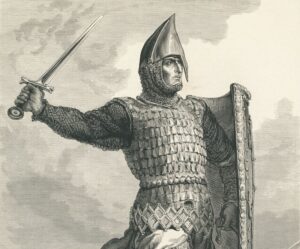
Only after Conrad of Masovia’s death in 1247 did Siemowit I receive the district of Czersk. His principality was originally supposed to include Łęczyca and Sieradz as well, but these territories were cunningly seized by Casimir of Kuyavia during the funeral ceremonies for Conrad, which Siemowit organized. The actions of his elder brother brought Siemowit closer to Bolesław, and after Bolesław’s unexpected death in 1248, Siemowit assumed control over all of Masovia.
In the autumn of 1248, Siemowit’s forces set out against the Yotvingians, accompanied by reinforcements sent by Ruthenians and Lesser Poles. However, the campaign ended in failure due to the defenders’ tactics of harassing the main invading forces. The Masovian prince took many captives from the attacked region and seized countless spoils.
Pereyasłava in Masovia
Between 1247 and 1248, Siemowit I married Pereyasłava, about twenty years his junior, the daughter of Daniel of Galicia–Volhynia, King of Ruthenia from 1253 to 1264. The prevailing opinion is that Bolesław of Masovia played the main role in arranging this marriage, having met Daniel in 1247 during Conrad of Masovia’s funeral and discussed the future of his younger brother. Agafia, who raised Siemowit and guaranteed amicable Polish–Ruthenian relations, may also have played a significant role in bringing the two rulers closer together.
After the wedding, Pereyasłava likely settled with Siemowit in Płock, where she could feel much safer than in Czersk, which was threatened by raids. At the local court, the duchess must have often encountered Agafia, the widow of Conrad of Masovia. It is difficult to say what kind of relationship developed between the women. Presumably, it was good, as no source records any scandal involving Pereyasłava.
Initially, the relations between the brothers Casimir and Siemowit, who saw each other frequently after 1249, suddenly soured in 1254. This was a consequence of the assembly in Raciąż, where Siemowit met with King Daniel and the Teutonic Knights, who allowed his father-in-law and son-in-law to conquer part of Yotvingian lands. Casimir could not accept the outcome of these talks, as he had entirely different plans for the pagan territories. In a desperate move, the Kuyavian prince abducted Siemowit and Pereyasłava and threw them into a dungeon.
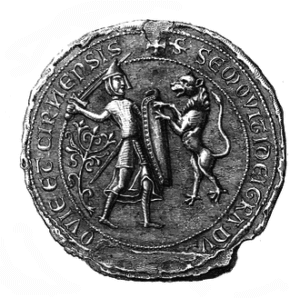
The Abduction of the Princely Couple
The imprisonment of Siemowit and Pereyasłava was first mentioned by the anonymous author of the “Greater Poland Chronicle” and later by Jan Długosz. The first source does not provide Pereyasłava’s name or the place where she was held. According to Długosz, Casimir imprisoned his brother and sister-in-law in Sieradz, though no other source confirms this. Could the chronicler have been mistaken? We cannot rule this out, especially since Długosz consistently refers to Pereyasłava as Gertrude, which is clearly an error.
The circumstances of Siemowit and his wife’s abduction are unknown. Scholars have suggested that they were attacked in May 1254 while returning from Cracow after ceremonies dedicated to St. Stanisław of Szczepanów. This theory is difficult to accept, as the exact timing of the Masovian couple’s abduction is unknown. All we know is that it occurred in 1254, which is too little to say anything certain about the circumstances.
According to M. Rukat, Casimir of Kuyavia “chose a rather inopportune moment to abduct Siemowit. His western and northern borders were insecure, and at any moment, his ally, King Ottokar II of Bohemia, might arrive in Prussia. It was also uncertain how Daniel of Galicia, King of Ruthenia, would react to news of his daughter and son-in-law’s imprisonment. We know nothing about the reactions of the allies. The sources are silent regarding any intervention by Daniel, Bolesław the Chaste, or the Teutonic Order. Perhaps the couple’s captivity was too brief to provoke a response at the Piast courts. One might ask why the prince’s allies did not react. The Teutonic Knights made no distinction between one Konradowic and another. By ensuring the neutrality of both toward themselves and hostility toward each other, they were the diplomatic victors of this skirmish. As for Daniel, it is difficult to give a definitive answer. Perhaps he considered the Yotvingian lands, bordering the Order and Masovia, lost and focused on the northern frontiers. It is surprising that he did not react to news of his daughter’s imprisonment. Or perhaps there was a reaction, but we simply lack the sources documenting it”.
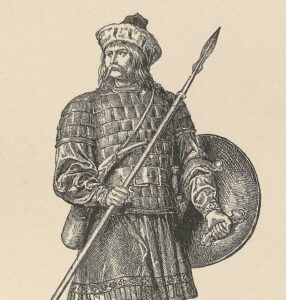
Pereyasłava’s time in captivity must have been a traumatic experience. She had likely heard from her husband about abductions among the Piasts, but surely never imagined she would suffer the same fate. Historians suspect that the duchess may have been imprisoned with her young children, Konrad and Bolesław. If we add that she was then pregnant with her soon-to-be-born daughter Salomea, it becomes clear that her situation was far from favorable. Siemowit, we may assume, pleaded with Casimir to release his children and pregnant wife, but we do not know how he responded.
Researchers believe that Siemowit and Pereyasłava were held captive for a maximum of four months. They were released thanks to the intervention of the papal legate and Bolesław the Chaste. It is unknown whether any agreement was reached between the feuding brothers on this occasion, though it is very likely.
The Death of Her Husband
Fate did not spare Pereyasłava, for just a few years after the traumatic events of her captivity, she was forced to come to terms with the death of her husband, who was killed in tragic circumstances. The crime was committed by Lithuanians, who in 1262 unexpectedly invaded the Masovian principality and plundered it. At the time, Lithuanian forces consisted of cavalry, allowing the attackers to move swiftly and efficiently through the targeted territory, and they acted by surprise, which brought them considerable gains.
During the raid on Masovia, the Lithuanians devastated and burned the principality’s capital – Płock. They also captured Jazdów, where Siemowit I and his twelve-year-old son Konrad were staying. In this stronghold, situated on a high escarpment, it was possible to defend oneself for a long time, which Siemowit attempted to do. According to sources, had it not been for the Lithuanians’ ruse – bribing a certain Goszcz to hand over Jazdów – Siemowit would have repelled the attacks of the plundering enemies. In the end, however, things turned out differently. As recorded in the “Annals of the Cracow Chapter,” the pagans not only burned Jazdów but also killed Siemowit, taking his son captive. The “Traska Annals” add that the prince’s body was burned.
The “Greater Poland Chronicle” records that Siemowit’s head was personally cut off by Prince Shvarno of Ruthenia, Pereyaslava’s elder brother, suggesting Ruthenian involvement in the 1262 raid. However, modern scholars are skeptical of this version, as there were no conflicts between the Masovians and Daniel of Galicia or his sons at the time. It is possible that the order to execute Siemowit came from Prince Eustachy Konstantynowicz of Ryazan, an enemy of the princes of Vladimir, who, according to the “Galician–Volhynian Chronicle,” led the forces ravaging Czersk in 1262.
There is no information that Pereyasłava was with her husband in Jazdów during the Lithuanian invasion. The absence of such a detail suggests she was not a witness to the tragic events that unfolded there. Her heart must have been pierced by grief when she was informed of Siemowit’s death. The pain was all the greater because she could not see her son, whom the pagans had taken to Lithuania. In such a difficult situation, almost any woman would have succumbed to mourning and despair. Yet the widow of Siemowit did not do so, demonstrating her extraordinary strength.
Pereyasłava – A Young Widow
Shortly after Siemowit’s death in 1262, Pereyasłava asked Bolesław the Pious to help her rebuild Płock. He granted her request, as recorded in the “Greater Poland Chronicle.” The Ruthenian princess based her regency, exercised on behalf of her underage sons Conrad II and Bolesław II, on an alliance with the prince of Greater Poland. Bolesław’s protection must have discouraged her brother-in-law, Casimir of Kuyavia, from entering Masovia and claiming the inheritance of his prematurely deceased brother Siemowit.
Pereyasłava seems to have officially blamed Casimir for her husband’s death. In documents from 1262–1263, Pope Urban IV also accused the Kuyavian ruler of supporting pagan tribes in their fight against the Teutonic Order, and the Teutonic Knights accused him of collaborating with Lithuania. It is also possible that, at Pereyaslava’s initiative, proceedings were launched against the traitor Goszcz, who, due to his crime, was likely executed on the spot.
By 1264 at the latest, Conrad was released from captivity. Historians believe that Pereyaslava spared no effort to help her son leave Lithuanian prison. She probably intervened with her Ruthenian relatives, who interceded with the Lithuanians on her and her son’s behalf. The results of her efforts must have come quickly, as one document notes that the captors held Konrad for a relatively short time.
In her final years, Pereyasłava focused on ensuring the stability of Masovia and safeguarding her children’s interests. She gradually withdrew from active politics, handing over power to her growing sons. She died on April 12, 1283, remembered as a regent devoted to Masovia’s affairs and a mother who, in the most difficult moments, managed to secure the continuity and safety of the Piast dynasty.
Bibliography:
-Dąbrowski D., Daniel Romanowicz, król Rusi (ok. 1201–1264). Biografia polityczna, Kraków 2012.
-Gieysztor A., Działania wojenne Litwy w roku 1262 i zdobycie Jazdowa, „Zeszyty Naukowe WAP, Seria Historyczna” 15 (1967).
-Grabowski J., Dynastia Piastów mazowieckich. Studia nad dziejami politycznymi Mazowsza, intytulacją i genealogią książąt, Warszawa 2012.
-Rukat M., Siemowit I Mazowiecki. Książę trudnego pogranicza (ok. 1215 – 23 czerwca 1262), Kraków 2018.

Rory Thornfield
Rory's grandfather left behind a wartime diary filled with accounts of a minor Burma skirmish that history books never mentioned. Reading it, Rory realized: behind every famous battle are dozens of forgotten struggles, each with its own human drama.
His preferred topics: The overlooked corners of military history – secondary campaigns, shadow battalions, local conflicts that never made headlines. From medieval sieges to twentieth-century expeditions, he focuses on the soldiers, not the generals. The people who faced impossible choices and carried those experiences forever.
Rory strips away the romanticism without losing respect for those who served. He combines tactical analysis with personal stories, examining human endurance and moral complexity rather than celebrating warfare. His writing is balanced, thoughtful, and deeply researched.
Outside work, Rory visits forgotten battlefields (now quiet farmland), photographs war memorials nobody tends anymore, and interviews veterans' families.