Mieszko I went down in history as the founder of the Polish state and the first ruler to accept baptism. But before he married the Bohemian princess Dobrawa, his romantic life looked completely different. According to some sources, he had as many as seven wives – and none of them were his wives in the Christian sense. Are these just rumors from medieval chroniclers, or rather an echo of pagan customs?
Slavic Polygamy
Gallus Anonymus attributed to Mieszko I the possession of seven wives during the period when he was still a pagan. A significant portion of historians to date have treated this number in purely symbolic terms. This was already done by Anonymus’s direct successor, Master Vincent Kadłubek, who cited in his work reflections on the symbolism of the number seven, drawn from the Old and New Testament. In Kadłubek’s assessment, Mieszko’s life alongside seven women represented a symbol of his seven deadly sins, and only his union with one (Dobrawa) signified joining with the one Church.
We can therefore safely consider the number given by Gallus as a meaningless ornament, which, however, does not immediately disqualify the information about Mieszko I’s polygamy. It turns out that polygamy was widespread among the Slavs at that time, as directly evidenced by authors of numerous written accounts, providing examples of rulers and nobles in whose company more than one woman permanently resided. Ruthenian sources attributed to Vladimir the Great the possession of seven wives before his acceptance of baptism. Meanwhile, in the company of the Pomeranian duke Wartisław – if we believe the source information – as many as twenty-four partners moved about.
Only a few could afford to have more than one wife, those who could afford to maintain a harem and provide the women residing in it with dignified living conditions, including accommodation and sustenance. The conclusion therefore suggests itself that the larger the harem, the greater were the ruler’s power and rank.

The Prince’s „Main” Wife
At one time, A. Brückner argued that polygamy did not occur at all among the Slavs, and that the ruler, apart from one legal spouse, surrounded himself with concubines. This claim was quickly questioned, because analysis of available written sources creates a completely different reality of the private life of Slavic tribes. It is assumed that among the princely wives there were certain differences in status. One of them was most likely the most important of the ruler’s wives, whose children inherited first, while the others did not play an important role.
While Gallus Anonymus called Mieszko I’s partners wives, Master Vincent Kadłubek spoke of the ruler’s adulteresses, with whom he spent nights in turn. Following the latter author, later chroniclers repeated this thread.
A certain Dzierzwa even developed Kadłubek’s story, writing about the prince’s entertaining himself with all the women simultaneously. Only the anonymous chronicler from Greater Poland (early 14th century), apparently considering his predecessors’ information as untrue and defamatory to Mieszko, wrote not a word about the Piast prince having concubines with him.
Gallus does not mention which of the anonymous women who sweetened Mieszko I’s life was his main „wife” and which played secondary roles. We also do not know how long our ruler lived in polygamy. No information has been preserved regarding offspring from these unions, nor do we know the names or fates of children born by the prince’s pagan wives.
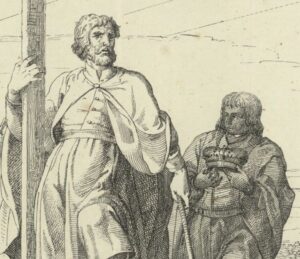
The End of Polygamy
Mieszko I’s polygamy ended with his marriage to a princess from Bohemia named Dobrawa. This marriage – in the light of well-informed sources – took place in 965. Under the mentioned date, the oldest Polish annals recorded a brief message with the following content: „Dobrawa arrives to Mieszko”.
Decidedly more on the matter of interest was written by Thietmar, Bishop of Merseburg, who was almost contemporary to the discussed event. According to him, Mieszko „in the Bohemian land took as wife the noble sister of Bolesław the Elder, who proved to be in reality what her name sounded like. She was called Dobrawa in Slavic, which translates in German as: good. This follower of Christ, seeing her husband immersed in manifold errors of paganism, pondered earnestly how she might win him over to her faith. She tried to win him over in every way, not for the satisfaction of the three lusts of this corrupt world, but for the benefits resulting from that glorious reward desired by all the faithful in the life to come. She deliberately acted wrongly for some time, so that she could later act well for a long time. When, namely, after the conclusion of the mentioned marriage, the period of Lent arrived and Dobrawa tried to make a voluntary offering to God by abstaining from eating meat and mortifying her body, her husband persuaded her with sweet promises to break her resolution. She agreed to this in order to be able to gain his obedience more easily in other matters. Some claim that she ate meat during one Lent, others that during three such periods […] She therefore worked on her husband’s conversion and the merciful Creator heard her. His infinite grace caused him who had so fiercely persecuted Him to repent and, at the constant urgings of his beloved wife, to rid himself of the poison of innate paganism, washing away the stain of original sin with holy baptism”.
Some specifics to the Saxon clergyman’s description were added at the beginning of the 12th century by the Anonymus called Gallus, writing at the court of Bolesław III Wrymouth. In his opinion, Mieszko I „was immersed in such errors of paganism that according to custom he enjoyed seven wives. Finally, he desired in marriage one very good Christian from Bohemia named Dąbrówka. But she refused to marry him unless he abandoned that depraved custom and promised to become a Christian. When he agreed to abandon that pagan custom and accept the sacraments of the Christian faith, that lady came to Poland with a great retinue of secular and spiritual dignitaries, but she did not share the marital bed with him until, slowly and carefully familiarizing himself with Christian custom and church laws, he renounced the errors of paganism and passed into the bosom of Mother Church”.

The Chosen One from Bohemia
We will find brief information about Dobrawa additionally in the Bohemian court environment, represented by the Prague canon Cosmas. Under the year 977, this clergyman recorded in his work: „Dąbrówka died, who because she was exceedingly shameless, when she married the Polish prince being already a woman of advanced age, removed the veil from her head and put on a maiden’s wreath, which was great foolishness of this woman”.
Mieszko I’s chosen one was the daughter of Bolesław I the Cruel (Thietmar’s version), although later sources did not exclude that Dobrawa’s father was Bolesław II the Pious (version of Gallus Anonymus), or Vratislaus I („Chronicle of Greater Poland”). It is difficult, however, to determine who the princess’s mother was. Existing hypotheses about her Slavic or German origin do not have sufficient support in the sources.
Besides two brothers, Strachkvas and Bolesław the Pious, Dobrawa had an older sister named Mlada. Mlada was a nun who, during the reign of Pope John XIII, stayed in Rome to obtain a bishopric for Bohemia, and received the pope’s consent in a letter most likely from 967.
Bibliography:
-Balzer O., Genealogia Piastów, wstęp J. Tęgowski, Kraków 2005.
-Banaszkiewicz J., Dąbrówka „christianissima” i Mieszko poganin (Thietmar, IV, 55-56; Gall, I, 5-6), [w:] Nihil superfluum esse, Studia z dziejów średniowiecza ofiarowane profesor Jadwidze Krzyżaniakowej, red. J. Strzelczyk, J. Dobosz, Poznań 2000.
-Strzelczyk J., Mieszko I – pierwszy historyczny władca Polski, [w:] Ojczyzna wielka i mała, Księga pamiątkowa wydana z okazji 40-lecia Oddziału Polskiego Towarzystwa Historycznego w Cieszynie, red. I. Panic, Cieszyn 1996.
-Strzelczyk J., Mieszko I w opiniach współczesnych i potomnych, [w:] Civitas Schinesghe, Mieszko I i początki państwa polskiego, red. J. M. Piskorski, Poznań-Gniezno 2004.

Margot Cleverly
Margot's journey into women's history began with a box of forgotten letters in a Cambridge archive – suffragettes whose voices had been silenced for over a century. Since then, she's been on a mission to uncover the stories history overlooked.
What she writes about: Queens who ruled from the shadows. Scientists whose male colleagues took credit. Revolutionaries who risked everything. But also ordinary women – those who survived wars, raised families through upheaval, and shaped their communities in ways no one bothered to record.
Margot turns historical figures into real people. She writes with warmth and detail, making centuries-old stories feel surprisingly relevant. Rigorous research meets accessible storytelling – no dusty academic jargon, just compelling narratives backed by solid facts.
When she's not writing, you'll find her in regional archives, collecting oral histories, or visiting sites connected to the women she writes about.