Before Leszek the Black married Gryfina, he had little in common with love and romance. Instead, he occupied himself with war, politics, and the struggle for influence. As a teenager, he had to deal with enemies who were plentiful even within his own family. For years, he learned to govern, conduct campaigns, and survive in the ruthless world of the Piasts. Who was young Leszek before Grzymisława appeared in his life?
Family Disputes
Leszek the Black, half-brother of King Władysław the Łokietek, is not a widely known figure. Historians indicate that this duke, who ruled Cracow for nearly ten years and, like Władysław, aspired to unite Poland, was not ultimately destined to accomplish this feat.
Leszek the Black came into the world between 1240 and 1242. His father was Duke of Kuyavia Kazimierz Konradowic, and his mother was Konstancja, daughter of Silesian Duke Henry the Pious. The epithet „the Black” („Niger”) first appeared at the beginning of the 14th century in the „Chronicle of Dzierzwa”. Leszek probably received it due to his dark hair color, though specialists’ opinions on this matter are divided.
After his mother’s death (in 1257), Leszek the Black, along with his younger brother Siemomysł, fell into conflict with their father, who did not remain in mourning for long and married Princess Euphrosyne of Opole (mother of Władysław the Łokietek). As a result of the rebellion he raised (1261), Leszek received administrative control of Łęczyca and Sieradz from his father. His endeavors were supported by Duke Bolesław the Pious of Greater Poland and Duke Bolesław V the Chaste of Kraków-Sandomierz.
The rebellious son did not retain the Łęczyca lands for long, losing them to his father in the second half of 1262. We know nothing of any military actions by either side. The border correction therefore probably occurred as a result of some agreement guaranteeing Kazimierz half of his rebellious son’s domain. It is believed this arrangement was made through the mediation of Bishop Wolimir of Kuyavia, who was in conflict with Kazimierz but worked very closely with Leszek and whose support he owed his several successes in struggles with his father.

It is not unlikely that Leszek himself sought an amicable settlement of affairs with Kazimierz, as he remained a strong ruler who claimed rights to his son’s lands. The value of Łęczyca and its surroundings was also diminished by its proximity to turbulent Mazovia, from where an unexpected attack could come at any moment.
Lord of Sieradz
Having surrendered the Łęczyca lands to his father, Leszek the Black became lord of the small Duchy of Sieradz, consisting of four castellanies: Sieradz, Spicymierz (with Spicymierz on the Warta), Rozprza (with Rozprza on the Luciąża), and Wolbórz (with Wolbórz on the Wolborka). These lands were sparsely populated and insufficiently developed economically. From the first years of his reign, the duke supported the founding of villages and towns under German law (Warta, Radomsko). It was thanks to his efforts that New Brzeźnica was established in 1265, which received municipal rights over twenty years later (1286). New arrivals, including craftsmen, were attracted to the newly founded towns. Leszek also ensured the maintenance of roads in good condition, on which bandits feared to travel and were suppressed by various means.
Leszek the Black’s actions made the Sieradz lands a local power. In the young duke, people recognized a capable administrator and good steward who cared for the duchy’s interests. In a short time, Kazimierz’s son’s popularity grew immensely, especially among ordinary knights and townspeople.
Leszek the Black’s seat was the stronghold in Sieradz, one of the stronger defensive points in Polish lands. It was fortified with a high wooden-earthen rampart surrounded by a deep moat and marshy floods of the Żaglina stream flowing into the Warta. The duke strengthened the stronghold even more by erecting a high stone-brick tower connected to the defensive walls. It towered over the entire area, providing a convenient observation point.

Pivotal Moment
During the first years of his reign, Leszek the Black actively supported Duke Bolesław the Chaste of Cracow. In 1260, he participated with him in the Battle of Kressenbrunn, in which King Béla IV of Hungary suffered a humiliating defeat, beaten by the Bohemian forces of Ottokar II Přemysl.
Soon after, a Hungarian-Bohemian rapprochement occurred, resulting in two dynastic marriages. Prince Béla, son of Béla IV, married Ottokar Přemysl’s niece Kunigunde, while Přemysl himself, after divorcing Margrave Margaret of Austria, married Kunigunde, daughter of Rostislav, Ban of Serbian Mačva, and Anna, daughter of Béla IV. The first wedding took place in Pressburg, the second in Prague.
Several years later (1265), Leszek the Black himself entered into marriage. His chosen bride was Gryfina. She was the daughter of the aforementioned Rostislav, who initially ruled in the Duchy of Halych, but was later forced to leave Rus’ and settled in the Banate of Mačva, offered to him by his father-in-law Béla IV. Since Gryfina’s father was no longer alive in 1265, she was given in marriage by her grandfather Béla, who reached an agreement on this matter with Bolesław the Chaste and Kinga – the bride’s aunt.
The wedding of Leszek and Gryfina took place in Cracow, where crowds of guests gathered. The groom was 22–25 years old at the time of the wedding, and his bride was 16–19. In times when marriages contracted by twelve- or fourteen-year-olds were the norm, and children were betrothed even in the cradle, the young couple was certainly considered mature and capable of undertaking marital duties. Even before the wedding ceremonies, the future spouses had to obtain papal dispensation because they had several common ancestors in the fourth and third generations.
New Stage in Life
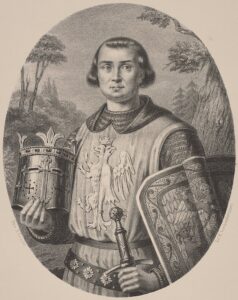
In the same year of 1265, after his marriage to Gryfina, Leszek the Black was adopted by Bolesław the Chaste and appointed as his successor. Previously, the Duke of Cracow had recognized his paternal cousins, Kazimierz of Kuyavia and Siemowit of Mazovia, as his successors, but following the unexpected death of the latter and the aggressive politics pursued by the former, Bolesław changed his mind, choosing the eldest of Kazimierz’s sons. This must have undoubtedly pleased Leszek, who through adoption strengthened family ties with his father’s paternal cousin.
Although the throne of Cracow was considered elective in the 13th century, the belief in the dynastic-hereditary right to transfer the title to rule over the Cracow duchy still persisted. During the solemn adoption ceremony, to which the nobles had to consent, witnesses were present – Bishop Paweł of Przemanków and Castellan Warsz Rawita, who supported the candidacy of the Duke of Sieradz to assume the throne.
The marriage to Gryfina connected Leszek the Black through kinship ties with the most distinguished rulers of Central-Eastern Europe, primarily King Béla IV of Hungary, who possessed extensive influence in Poland, Bohemia, and Rus’. Thanks to this marriage, Leszek’s position – previously an insignificant Piast duke ruling a small duchy in the central part of Piast lands – was significantly strengthened. From then on, the ruler of Sieradz officially entered the world of grand politics, in which he would remain until the end of his days.
Bibliography:
-Barański M.K., Dynastia Piastów w Polsce, Warszawa 2005.
-Barciak A., Czechy a ziemie południowej Polski w XIII oraz początkach XIV wieku, Katowice 1992.
-Chmiel L., Leszek Czarny 1240–1288, Warszawa 1978.
-Karwasińska J., Polityczna rola biskupa Wolimira, „Ateneum Kapłańskie” 1928, t. 22.
-Mitkowski J., Leszek Czarny, [w:] Polski słownik biograficzny, t. 17, Wrocław 1972.
-Piszczowska M., Gryfina, [w:] Polski słownik biograficzny, t. 9, Wrocław 1960–1961.
-Samsonowicz H., Leszek Czarny, [w:] Poczet królów i książąt polskich, red. A. Garlicki, Warszawa 1980.

Marcus Renfell
Marcus Renfell is a historian driven by curiosity and passion. He refuses to accept the “safe,” polished versions of the past. Instead, he brings forgotten, overlooked, and distorted stories back to life. His work blends scholarly precision with the art of storytelling, turning historical narratives into vivid, page-turning experiences.
His mission is simple: to prove that history can be gripping, alive, and deeply personal.
His debut book: Women of Science. Stories You Were Never Told
In his first publication, Marcus Renfell shines a light on the remarkable women who shaped the world of science — both the pioneers whose names we know and the brilliant minds history forgot. It’s an inspiring journey through untold stories, groundbreaking achievements, and the resilience of women who changed our understanding of the world.
? Discover Women of Science. Stories You Were Never Toldon Amazon.com.