We all know him as Mieszko I – the first historical ruler of Poland. But was that really his name? In sources from his era, his name appears in surprisingly different forms, and some researchers even claim that… Mieszko is an error! Where did this name come from and can we be certain that it wasn’t accidentally distorted?
Mieszko, but Which One?
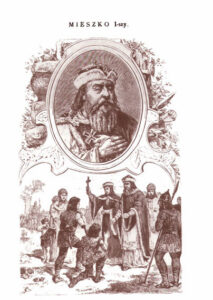
The figure of Mieszko I conceals many unsolved mysteries, and one of them is connected with his name. We have absolutely no certainty that the founder of the Polish state was really called „Mieszko”. It so happens that in accounts from his era, his name survived in various forms, while in the form known to us today it appears only at the end of the Middle Ages, over four centuries after the duke’s death.
Earlier, both in written texts and on coins, the Gniezno ruler appeared as Misaca, Misaco, Miseco, Meško, Misico, Miesico, Mesico, Miszego, Misigo, Misacho, Misicho, Mesco, Misko, Mysco, or Mesko, among others.
We can see therefore, that this name occurred in three basic versions with the endings -ka, -ek, and -ko. Most frequently in sources (German as well as Polish) the version with the last of the mentioned endings appears. As researchers noted, almost every generation of Piasts ruling in Poland until the 14th century had someone bearing the name Mieszko. The last representative of the dynasty to have this name was the Bishop of Nitra and Veszprém in Hungary, son of Duke Casimir of Bytom who died in 1344.
The Duke’s Name in Sources
Starting from the Middle Ages, attempts were made to explain the meaning of the name „Mieszko”, commonly regarded as a diminutive form. The first to undertake this task was Master Vincent Kadłubek, writing at the beginning of the 13th century: „He was called Mieszka, that is confusion, because his parents were troubled when he was born blind. Or in a hidden meaning, because from him, it seems, the seed of spiritual struggle was cast”.
A peculiar theory was also presented by the author of the 14th-century „Greater Poland Chronicle”: „Siemomysł begot a son from his wife, who being born blind was raised in blindness for seven years. The Poles, seeing this, greatly worried that King Siemomysł had not sired another son in the course of seven years, said: 'Behold, there will again be confusion in the kingdom!’ For Mieszka, or turmoil, is named from disturbance. They knew that after the death of Chościsko, who was devoured by mice, numerous disturbances arose in the Polish state, so they feared their renewed outbreak and therefore called the king’s blind son Mieszko”.
This motif was later developed by Jan Długosz, who wrote: „It pleased the father and dignitaries to call him Mieszka, which in the Polish language means confusion or commotion, because due to his blindness from birth he was a cause of confusion for his parents and the Polish nation, and after Siemomysł’s passing he was to cause even greater confusion, as the Polish dignitaries and nobility feared, often repeating that after the death of his father, Duke Siemomysł, there would reign in Poland even greater turmoil than that which occurred after Popiel’s death”.
A bit further, Długosz cited yet another etymology of the Piast ruler’s name: „Some believe that the little duke was called Mieczysław, which means destined to have glory, and that this name passed into Mieszko through the diminutive calling of him when he was a child. This view we also share for many reasons, considering that Poles were accustomed to ending the names of their kings and dukes not with 'ko’ but with 'sław,’ forming them in their language: Władysław, Bolesław, Mieczysław, Przemysław, Stanisław”.
Historians’ Disputes
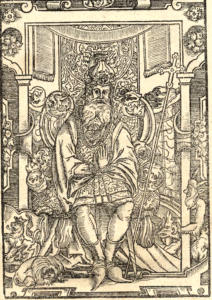
Linguists did not agree with Jan Długosz’s erudite argument, according to whom both this chronicler and his predecessors had absolutely no idea what was hidden under that enigmatic name. In reality, this state continues to this day, because scholars of various specializations have not been able to propose an etymology that would meet with universal acceptance.
Moreover, new theories in this interesting matter continue to appear. At one time, A. Brückner’s concept, deriving Mieszko’s name from miś (bear), enjoyed great popularity. The conclusions of German historian R. Holtzmann, according to whom the Piast duke’s name referred to mice, were considered a curiosity! W. Semkowicz sought in the name Mieszko the biblical name Misach. In turn, J. Dowiat advocated for the non-Slavic genesis of Mieszko’s name, considering this name a diminutive form of the Christian name Michael. According to the same researcher, this same Michael, then Bishop of Regensburg, baptized Mieszko.
Linguist W. Taszycki derived Mieszko from the two-part names Mietsław and Mieczysław. J. Otrębski and S. Rospond pulled their linguistic interpretation in a similar direction, claiming that Mieszko constitutes an abbreviation of the two-part Slavic names Casimir, Siemomysł, or Dobromysł.
M. Rudnicki argued, that Mieszko was most likely a shameful nickname. In one of his texts, German Slavist H. Kunstmann proposed deriving Mieszko’s name from the name of the inhabitants of Balkan Moesia, from where – as the scholar maintained – the mentioned duke, or his lineage, had come to Poland.
Solving the mystery concerning the name of the first Christian ruler of Poland is impossible at the current stage of research, though it is not excluded that cooperation between linguists and historians will someday change this state of affairs. Thanks to the thorough analysis of J. Hertl (in the study „The Nomenclature of the Piast Dynasty in the Earlier Middle Ages”), it should be accepted as almost certain that the most correct form of the Polish duke’s name is Mieszko. This name most likely constitutes a diminutive of some native personal name, whose full form has not been preserved in the written sources known to us.
Another Name for Mieszko?
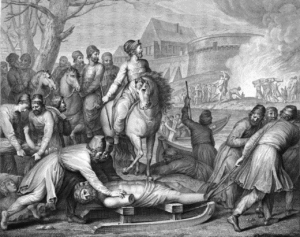
„This Siemomysł begot the great and famous Mieszko, who first bore this name”. The words „who first bore this name”, coming from the work of Gallus Anonymus, constitute another unexplained mystery that several generations of native historians have grappled with. Often with varying success.
It is worth noting in this context that the Anonymous’s chronicle has been preserved in three manuscript versions, of which only one (the Heilberg manuscript) contains a reading corresponding to the above translation („qui primus nomine vocatus illo”). In turn, in the two remaining manuscripts (Sędziwój and Zamoyski) instead of „illo” („this,” „that”) the word „alio” („other”) appears, which absolutely makes no sense in this case. Consequently, editors of the chronicle change the „primus” („first”) found in all manuscripts to „prius” („earlier”), which should be translated: „who earlier bore another name”.
Dual naming of rulers in the period under consideration was quite widespread in many states among various dynasties, including among the Piasts in Poland. For example, Mieszko II (1025-1034) bore the second name Lambert, Casimir the Restorer (1034-1058) – Charles, and Wladysław (1079-1102) – Herman. Particularly often two names were used by neophytes after accepting the Christian faith, of which one name was received during the baptism ceremony. Some scholars suggested that it was similar in the case of the Piast duke. According to H. Łowmiański, Mieszko adopted the name Dagobert during baptism, represented by Frankish rulers from the Merovingian dynasty (one of them was Dagobert II, who died in 679 and was later canonized).
Łowmiański’s theory did not meet with recognition from his scholarly opponents, who formulated against it a series of important arguments undermining its general value. It was pointed out, among other things, that if Mieszko I really held the cult of Dagobert in special regard, then some traces of it should have survived in Poland, which unfortunately we do not observe in the scantily presented source material. It was also emphasized that the name given to Mieszko in 966 could not have been a Christian name, because the leading chroniclers of the time, headed by Thietmar and Widukind, used only the name given to him by his father.
Moreover, Mieszko I himself gave this name to his son, born from Oda, mentioning it alongside his own in the famous document known from its first words „Dagome iudex.” Indeed, the same name was received by the duke’s grandson, Mieszko II, son of Boleslaw the Brave and his third wife Emnilda. No one at that time, therefore, thought to give Mieszko I’s firstborn son, born just after his father’s baptism, a different or additional „Christian” name other than Bolesław.
„Dagome iudex”
Historians investigating the question of Mieszko I’s „other” name had to grapple, willingly or unwillingly, with the aforementioned document „Dagome iudex”. It is difficult to determine why Mieszko I appears in it under the name Dagome, which occurs nowhere else. There is probably no need to convince anyone that no compromise has been reached in this interesting matter, and scholars have arrived at various and sometimes contradictory conclusions.
According to some experts on the subject, in the case under discussion we are dealing with Mieszko’s first name, which was most likely distorted by a copyist who did not know how to write in Latin alphabet a foreign-sounding word. In this context, W. A. Maciejowski’s conjecture falls into complete void, according to which „Dagome” was a German translation of the alleged Slavic name Mieczysław.
W. Semkowicz advocated for the originally pagan name of our duke in his works, maintaining that the root „Dag” should be understood as „good”. M. Rudnicki concluded that „Dagome” referred to the name of the Polabian deity Podag, mentioned in the text of Helmold of Bosau in the 12th century. A. Bielowski, meanwhile, identified the word considered here with the Bavarian name Tagino, borne by the Archbishop of Magdeburg contemporary to Boleslaw the Brave. There were also scholars who drew attention to the possibility of Scandinavian origin of the name „Dagome.” The last of these hypotheses, strongly promoted especially by German historians trying to prove the Norman (or German) origin of Mieszko I, is still quite popular today, although among professional historians it is considered a theory pulled out of thin air, around which too much artificial noise is made.
For several decades now, however, the view has enjoyed success that the words „Dagome iudex” arose as a result of combining three words from the original document: DAGO MESCO DUX. According to L. Kolankowski, the author of this idea, the name „Mesco” split into two parts. The first, improperly attached to the word „Dago,” gave the new word „Dagome,” while the second part „sco” was read as „iu” and combined with the final word „dux.” As Kolankowski noted, this last word was also most likely misunderstood and instead of „dux” the word „iudex” was created.
L. Kolankowski’s theory, initially strongly challenged by a number of scholars, ultimately survived in scholarship, but with certain modifications. Thus, according to W. Hejnosz, the term „Dagome iudex” was supposed to have arisen not from the combination of words DAGO MESCO DUX, but DAGO MESCO REX. B. Włodarski approached the matter somewhat differently, accepting the creation of the expression „Dagome” from the combination of the Christian name „Dago” and the pagan „Mesco,” which was already written in abbreviated form in the register as „Me.” The last version was additionally argued in his insightful considerations by J. Hertel, whereby this hypothesis seems to be the best justified of all those put forward in historiography so far.
On the other hand, however, one cannot forget about the critical voices expressed in the matter that interests us here. It is impossible to pass indifferently by, among others, the opinion of K. Buczek, who clearly stated: „I think that combinations based on the Dagome iudex register regarding Mieszko I’s baptismal name should be ended, because it is quite improbable that he would have issued an act of donation of the Gniezno state not under the name under which he appears in Polish, Czech, and German sources, not excluding the chronicles of Widukind and Thietmar. This testifies that he did not use another name at all and – truth be told – could not use one, especially in political actions, because at the time of baptism he was an adult man and had behind him at least several years of rule over the state. The same, incidentally, as with Mieszko, was the case with almost all the first Christian rulers”.
Bibliography:
-Bogucki A., Kilka uwag o imieniu Mieszka I, [w:] Społeczeństwo Polski Średniowiecznej 10 (2004).
-Buczek K., Zagadnienie wiarygodności regestu Dagome iudex, „Studia Źródłoznawcze” 10 (1965).
-Labuda G., Rzekome drugie imię Mieszka I w kronice Anonima Galla, [w:] Munera Philologica et Historica Mariana Plezia oblata, Wrocław 1988.
-Rospond S., Uwagi polemiczne o Mieszku, Masławie i Dąbrówce, „Onomastica” 1 (1955).
-Skibiński E., Mieszko I, Przyczynki do biografii, „Historia Slavorum Occidentis” 10 (2016).
-Wiszewski P., Domus Bolezlai, W poszukiwaniu tradycji dynastycznej Piastów (do około 1138 roku), Wrocław 2008.

Marcus Renfell
Marcus Renfell is a historian driven by curiosity and passion. He refuses to accept the “safe,” polished versions of the past. Instead, he brings forgotten, overlooked, and distorted stories back to life. His work blends scholarly precision with the art of storytelling, turning historical narratives into vivid, page-turning experiences.
His mission is simple: to prove that history can be gripping, alive, and deeply personal.
His debut book: Women of Science. Stories You Were Never Told
In his first publication, Marcus Renfell shines a light on the remarkable women who shaped the world of science — both the pioneers whose names we know and the brilliant minds history forgot. It’s an inspiring journey through untold stories, groundbreaking achievements, and the resilience of women who changed our understanding of the world.
? Discover Women of Science. Stories You Were Never Toldon Amazon.com.